How 500 scoring works
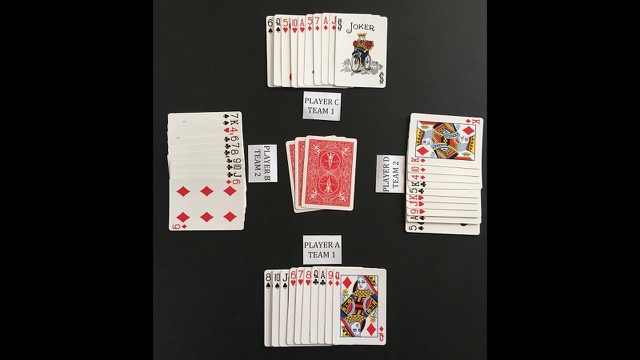
500, or Five Hundred, is a trick-taking game for four players in two partnerships. Everyone gets ten cards and three go face down to the kitty. Players bid for the right to name trump, the winner takes the kitty and discards three, and then ten tricks are played. The side that won the bid, the contractors, has to take at least the number of tricks it bid. Each hand, the contractors score their bid or lose it, and the other side scores for the tricks it took. The first side to reach 500 by making a bid wins.
What each bid is worth
This is the Avondale schedule, published by the US Playing Card Company in 1906 and still the standard table. pagat.com and Wikipedia give the same values. Suit and no-trump bids rank by their value, so a higher number beats a lower one.
| Tricks | ♠ Spades | ♣ Clubs | ♦ Diamonds | ♥ Hearts | No trumps |
|---|---|---|---|---|---|
| 6 | 40 | 60 | 80 | 100 | 120 |
| 7 | 140 | 160 | 180 | 200 | 220 |
| 8 | 240 | 260 | 280 | 300 | 320 |
| 9 | 340 | 360 | 380 | 400 | 420 |
| 10 | 440 | 460 | 480 | 500 | 520 |
🙈 Misère is worth 250 and ranks above any seven bid and below any eight bid. 👀 Open misère is worth 500, ranking above ten diamonds and below ten hearts. It is a misère played with the bidder's cards face up on the table.
Making the bid, or going down
If the contractors take at least the tricks they bid, they score the bid's value. Extra tricks earn nothing. If they fall short, the value comes off their score, which can take them below zero. Either way, the other side scores 10 for each trick it won.
A slam is all ten tricks. pagat.com's rule is that a slam on a bid worth less than 250 scores 250 instead of the bid. A slam on a bid worth 250 or more scores just the bid. Wikipedia lists the slam bonus as a variant, so check that your table plays it.
Misère
In a misère the bidder plays alone, with no trump, and the partner lays their cards face down and sits out. The bidder is trying to lose every trick. Losing them all scores 250 (500 for open misère). Winning even one costs the same amount. The opponents score nothing on a misère hand, whatever happens.
An example hand
Your side bids seven hearts, worth 200, and takes eight tricks. You made it, so you score 200, and the other side scores 20 for its two tricks. Take only six tricks instead and you are one short: 200 comes off your score and the other side scores 40 for its four. If you had bid six spades (40) and taken all ten, the slam would score 250 instead of 40.
Who wins
A side wins by reaching 500 or more as a result of making its own bid. pagat.com is clear that reaching 500 on tricks won as defenders is not enough, so play continues until one side gets there by winning a contract. A side that falls to minus 500 or worse loses. Wikipedia notes that the original 1904 rules let a defending side that reached 500 first take the game, and some tables still play that way.
Using this score sheet
What do I enter for each hand?
The bidding side enters its bid's value from the table above and the tricks it won. The other side enters only its tricks. The sheet works out how many tricks the bid needed, then scores the bid, minus the bid, or 250 for a slam, and gives the other side 10 a trick.
How do I enter a misère?
Put 250 (or 500 for open misère) in the bidder's Misère box instead of the Bid box, and the bidder's tricks in Tricks won: 0 if they lost every trick. Leave the other side's tricks at 0, since the opponents score nothing on a misère. Misère has its own box because open misère and ten hearts are both worth 500.
Why does it say players when we play in teams?
Each column is one side. Name them after the partners, like "Ann and Joe," and enter the tricks the two of you won together. The deal passes clockwise every hand, so it alternates between the sides, and the sheet shows whose side deals.
The other side passed 500 but we are still playing. Is the sheet wrong?
No. The sheet shows totals, and under pagat.com's rules points from defending cannot win the game. Keep playing hands until a side reaches 500 by making its bid. If your table plays the 1904 rule, the first side to 500 wins however it got there.
Can we play three-handed?
Yes. Add a third player and each column is one person. The high bidder plays alone against the other two, and pagat.com keeps each player's score separately. Enter each player's own tricks in their column.
We use a different bid table. Will the sheet still work?
For suit and no-trump bids the sheet reads the trick count from the Avondale values, so a value from another table may be matched to the wrong number of tricks. If your table differs, enter each side's hand score with the mistake offset, or check the result after each hand.
How do I add a hand?
In guided entry, tap Next round after entering both sides' numbers. On the score sheet, tap Add round. If you added one by mistake, Remove last round takes it off.
What is the mistake offset for?
For fixing a total without hunting for the hand it went wrong in. Add or take away points there.
Are my scores saved?
Yes, in your browser's storage on this device. Close the tab between hands and everything is still there. Nothing is sent to us.
500 is a traditional card game. The rules here follow four-handed Five Hundred with the Avondale bid schedule, as described on pagat.com and checked against Wikipedia. This sheet is for the trick-taking game, not 500 Rum. ScorePad HQ is an independent score sheet and is not affiliated with any card or game publisher.