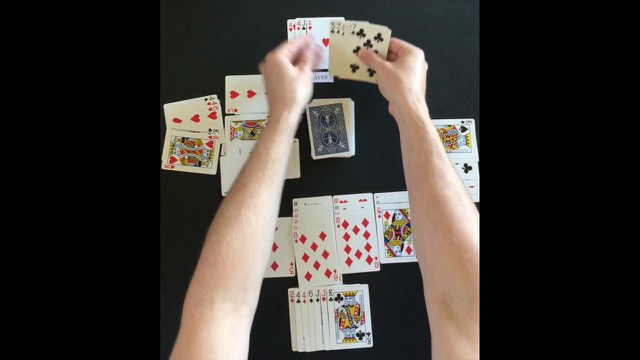
How Canasta scoring works
Canasta is usually played by four people in two partnerships, and partners share one score. At the end of each hand, each side adds its bonuses to the value of every card it melded, then takes off the value of the cards still in both partners' hands. That hand score goes onto the running total, and the first side to reach 5,000 at the end of a hand ends the game.
| Bonus | Points |
|---|---|
| ✨ Natural canasta (no wild cards) | 500 |
| 🔀 Mixed canasta (with wild cards) | 300 |
| ♦️ Each red three | 100 |
| ♥️ All four red threes | 800 in all |
| 🚪 Going out | 100 |
| 🤫 Going out concealed | 100 more |
| Card | Points |
|---|---|
| 🃏 Joker | 50 |
| 🅰️ Ace or 2 | 20 |
| 🤴 King, Queen, Jack, 10, 9 or 8 | 10 |
| 🔢 7, 6, 5, 4 or black 3 | 5 |
Red threes and the minus score
Red threes are laid face up on the table instead of being kept in hand, and they're never part of a meld. They count for a side that has made at least one meld that hand. If your side hasn't melded anything when the hand ends, the same red threes count against you, so a hand score can be a minus. Going out concealed means melding your whole hand in one turn, including at least one canasta, without having melded earlier.
An example hand
Your side goes out holding a natural canasta of seven Kings (500 + 70), a mixed canasta of five 8s and two 2s (300 + 50 + 40) and one red three (100), plus 100 for going out. That's 1,160. Their side melded three Queens (30) and has one red three (100), but an Ace and a 7 are still in hand (20 + 5). They score 30 + 100 − 25 = 105.
Your first meld gets bigger as you score
The cards in a side's first meld of a hand have to add up to a minimum count, and that minimum depends on the side's total at the start of the hand. Bonuses don't count toward it. Some rule sets, including pagat.com's, drop the minimum to 15 while a side's total is below zero.
| Your side's total | Minimum first meld |
|---|---|
| 0 to 1,495 | 50 |
| 1,500 to 2,995 | 90 |
| 3,000 or more | 120 |
Who wins
The game ends after the hand in which a side reaches 5,000 or more. The higher total wins, even if both sides went past 5,000 on the same hand. There's no bonus for winning. The rules don't give a tiebreaker, so a tie is shared.
Using this score sheet
Why does it say players when we play in teams?
Each column is one side. Name them after the partners, like "Ann and Joe," and enter one score per side per hand. For a two-handed game, each player is a side.
How do I enter a minus score?
Type a minus sign before the number, or tap the ± button in guided entry. A side that didn't meld and is holding red threes will usually go below zero for that hand.
We play to a different total. Can I change it?
Yes. Change Points to win on the setup screen. Some rule sets play three-handed and six-player games to a higher total than 5,000, so set it to whatever your rules use.
How do I add a hand?
In guided entry, tap Next round after entering both sides' scores. On the score sheet, tap Add round. If you added one by mistake, Remove last round takes it off.
What is the mistake offset for?
For fixing a total without hunting for the hand it went wrong in. Add or take away points there.
Are my scores saved?
Yes, in your browser's storage on this device. Close the tab between hands and everything is still there. Nothing is sent to us.
Canasta is a traditional card game, and the rules here follow the classic North American version. ScorePad HQ is an independent score sheet and is not affiliated with any card or game publisher.