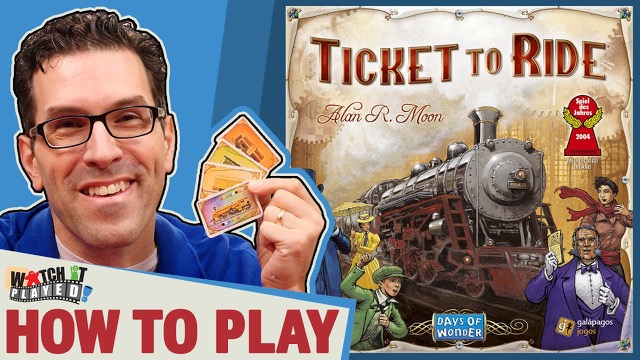
How Ticket to Ride scoring works
You score most of your points during the game, on the track around the board, every time you claim a route. When someone gets down to 2 trains or fewer, everyone takes one last turn. Then you reveal your destination tickets, add the ones you connected, take off the ones you didn't, and hand out the Longest Continuous Path bonus. The rulebook suggests recounting everyone's routes at the end too, since markers get bumped. This sheet follows the current USA rules, 2015 printing.
| Source | Points |
|---|---|
| 🚃 Routes | By length: 1 train scores 1, 2 trains 2, 3 trains 4, 4 trains 7, 5 trains 10, 6 trains 15. |
| 🎫 Completed tickets | The value printed on each ticket you connected. |
| ❌ Incomplete tickets | The value of each ticket you didn't connect, taken off. |
| 🛤️ Longest Continuous Path | 10, for the longest unbroken line of your own trains. |
| 🌎 Globetrotter | USA 1910 only. 15, for completing the most tickets. |
Counting routes
Going over the whole board can feel slow, but it's the reliable way. For each player, count their routes of each length and enter the numbers. The sheet turns them into points with the table above. Long routes are worth far more than short ones: a single 6-train route scores 15, while six 1-train routes score 6.
Longest Continuous Path
Only your own trains count, and the path can loop and pass through the same city more than once, but no train can be counted twice. If two or more players tie for longest, they all score the 10 points. On the sheet, enter 1 for each player who gets it.
Breaking a tie
If players finish level on points, the one who completed the most destination tickets wins. The sheet asks for that count with the ticket points, so it settles the tie on its own. If they're still level, the player holding the Longest Continuous Path card wins.
USA 1910
The USA 1910 expansion adds new tickets and the Globetrotter card, worth 15 to the player who completed the most tickets. Turn on USA 1910 in the setup to add its row. In the 1910 variant, Globetrotter replaces the Longest Path bonus, so leave Longest Path empty. The Mega Game uses both bonuses. For Big Cities, check your rulebook for which bonus to use.
Using this score sheet
Can I just use the score from the track?
Yes. Type the track score into the mistake offset and skip the route row. You'll still want the ticket rows and the bonuses, since the track doesn't include them until the end.
What is the mistake offset for?
For anything the rows don't cover, or a correction you spot later. Add or take away points there. It can be positive or negative.
Are my scores saved?
Yes, in your browser's storage on this device. Close the tab and your game is still there when you come back. Nothing is sent to us.
Does it work for Ticket to Ride: Europe?
Not yet. Europe has stations and 8-train routes, which this sheet doesn't count. It's built for the USA map and the USA 1910 expansion.
Ticket to Ride is a game by Alan R. Moon, published by Days of Wonder. Ticket to Ride is a trademark of Days of Wonder, Inc. ScorePad HQ is an independent score sheet and is not affiliated with or endorsed by Days of Wonder.