How Sushi Go Party! scoring works
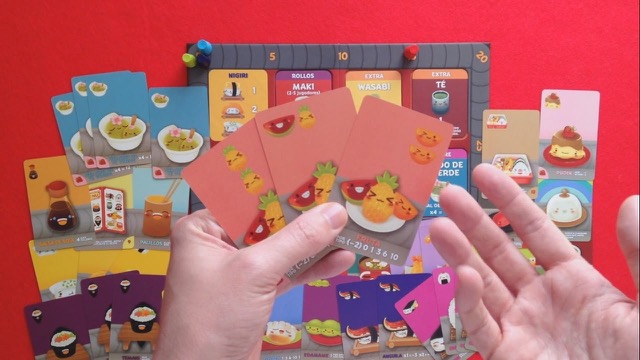
A game is three rounds. At the end of each round, everyone scores the cards in front of them and moves their pawn along the board's score track. Dessert cards are the exception: you set them aside each round and score them once, after the third round. Before the game you build a menu: nigiri, one kind of roll, three appetizers, two specials and one dessert. Only the cards on your menu score, so set the same menu on this sheet.
| Card | Points each round |
|---|---|
| 🍣 Nigiri | Egg 1, salmon 2, squid 3. Triple on a wasabi: 3, 6, 9. |
| 🌀 Maki | Count icons. Most 6, second 3. With 6 to 8 players: 6, 4, 2. |
| 🌯 Temaki | Most cards 4, fewest loses 4 (no penalty with 2 players). |
| 🍥 Uramaki | First three to reach 10 icons score 8, 5, 2. |
| 🍤 Tempura | 5 per pair. |
| 🐟 Sashimi | 10 per set of 3. |
| 🥟 Dumpling | 1, 3, 6, 10, then 15 for 5 or more. |
| 🐍 Eel | 1 loses 3. 2 or more score 7. |
| 🧈 Tofu | 1 scores 2, 2 score 6, 3 or more score 0. |
| 🍙 Onigiri | Sets of different shapes: 1, 4, 9, 16. |
| 🌱 Edamame | 1 per opponent with any edamame, up to 4 per card. |
| 🥣 Miso soup | 3, unless another miso soup was played the same turn. |
| 🍶 Soy sauce | 4 each if you have the most background colors (ties count). |
| 🍵 Tea | 1 per card in your biggest single-color set. |
| 🥡 Takeout box | 2 per card you flipped face down. |
| Dessert | Points at game end |
|---|---|
| 🍮 Pudding | Most 6, fewest loses 6 (no penalty with 2 players). |
| 🍨 Green tea ice cream | 12 per set of 4. |
| 🍉 Fruit | Each fruit on its own: 0 icons loses 2, then 0, 1, 3, 6, and 10 for 5 or more. |
Ties for most and fewest
In Sushi Go Party!, tied players all get the full points. The rulebook's maki example: Chris and Meredith have 5 maki icons each, Kerry has 3 and Andrew has 1. Chris and Meredith both score 6, and Kerry still scores 3 for second. For temaki and pudding, the fewest includes players with none, and everyone tied for fewest loses the points. You need at least one maki card to score for maki. The sheet takes everyone's counts and works all of this out.
Examples from the rulebook
Onigiri: a circle, a triangle and two squares make a set of 3 shapes (9) and a set of 1 (1), so 10 points. Fruit: 0 watermelon, 1 orange and 4 pineapple icons score minus 2, 0 and 6, so 4 points. A player with no fruit at all loses 6. Edamame: Chris has 3 edamame, Kerry has 2 and Andrew has 1. Chris has two opponents with edamame, so each of his is worth 2, for 6 points.
Breaking a tie
If players finish level, the tied player with the most dessert cards wins. If that's level too, you share the win.
Using this score sheet
How do I set the menu?
Turn on the chips for the cards in your game. The sheet starts on the rulebook's "Sushi Go!" menu, the one from the original game: maki, tempura, sashimi, dumplings and pudding, plus chopsticks and wasabi. Chopsticks, spoon, menu, special order and wasabi never score points of their own, so they have no row. Wasabi's bonus goes in the nigiri row, and a special order counts as whatever card it copies.
Why does each row have three boxes?
One for each round. After round 1, fill in the first box in each row and leave the others empty. The total keeps up as you go. Desserts only count at the end, so leave them until after round 3.
Why do some rows take points instead of a count?
Uramaki is scored during the round, in the order players reach 10 icons. Edamame depends on how many opponents have it, onigiri on how you group your shapes, and tea on your color sets. For those, work out the points with the table above and type them in.
What if every player has the same number of pudding or temaki?
The Sushi Go Party! rulebook doesn't cover it. The original Sushi Go! rules say nobody scores or loses pudding points in that case, and the sheet does the same for pudding and temaki. If your table plays it differently, use the mistake offset.
What does the printable sheet look like?
On paper it's one row per round and one for desserts, the same steps as the board's score track. Use the tables above to add up each round. The online sheet does that adding for you.
Are my scores saved?
Yes, in your browser's storage on this device. Close the tab and your game is still there when you come back. Nothing is sent to us.
Sushi Go Party! is a game by Phil Walker-Harding, published by Gamewright. ScorePad HQ is an independent score sheet and is not affiliated with or endorsed by the publisher.