How Pinochle scoring works
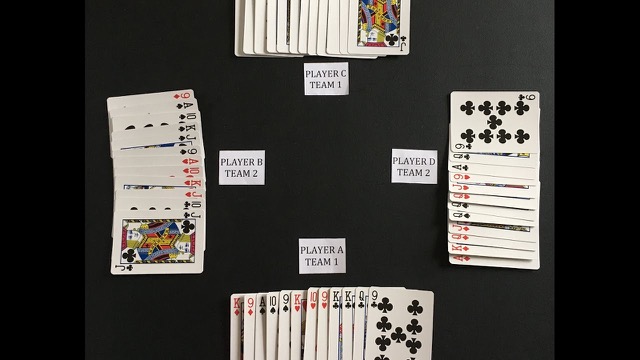
Partnership auction Pinochle is played by four people in two sides, with a 48-card deck: two each of ace, ten, king, queen, jack and nine in every suit. Each hand has three parts. The players bid for the right to name trump, both sides lay down their meld, and then twelve tricks are played for the counters. A side's score for the hand is its meld plus its counters, with one catch: the side that won the bid has to reach its bid with those two numbers, or it scores nothing and loses the bid. The first side to 1,500 wins.
Meld values
These are the values pagat.com and Wikipedia agree on. A card can count in two melds of different kinds, such as the queen of spades in a pinochle and in queens around.
| Meld | Points |
|---|---|
| 🏃 Run: A, 10, K, Q, J of trump | 150 |
| 🏃🏃 Double run (both of each) | 1,500 |
| 👑 Royal marriage: K and Q of trump | 40 |
| 💍 Marriage: K and Q of another suit | 20 |
| 9️⃣ Dix: the nine of trump, each | 10 |
| 🃏 Pinochle: Q of spades and J of diamonds | 40 |
| 🃏🃏 Double pinochle | 300 |
| 🅰️ Aces around: one ace of each suit | 100 (all eight: 1,000) |
| 🤴 Kings around | 80 (all eight: 800) |
| 👸 Queens around | 60 (all eight: 600) |
| 🤵 Jacks around | 40 (all eight: 400) |
Tables differ on the extras. pagat.com's family rules give 190 for a run with an extra king or queen in it and 230 for a run with an extra royal marriage. Wikipedia lists a roundtable (a marriage in every suit) at 240. Count whatever your table agrees on: the sheet only needs the total.
Counters from the tricks
In the modern count, each ace, ten and king taken in a trick is worth 10, and the last trick is worth 10 more, so 250 points are in play every hand. Older rules count ace 11, ten 10, king 4, queen 3 and jack 2, with 10 for the last trick, which also comes to 250. Bicycle's two-handed Pinochle uses that older count.
Making the bid, or going set
The side that won the auction adds its meld and its counters and compares them to the bid. If the total reaches the bid, the side scores all of it. If it falls short, the side is set: its meld and counters score nothing and the bid is taken off its score, which can put it below zero. The bidders can also give up before the play if they can see they won't make it, and are set for the bid. The other side scores its own meld and counters either way. pagat.com adds one condition: the non-bidding side keeps its meld only if it takes at least one counter or the last trick.
An example hand
Your side wins the bid at 300 and melds 190: a run (150) and a pinochle (40). In the play you take 120 in counters. That's 310, which reaches the bid, so you score 310. Take only 100 in counters instead and you have 290, ten short: you're set, and 300 comes off your score. The other side melded 60 and took the rest of the counters, so it scores 60 plus its counters whatever happens to you.
Who wins
The first side to reach 1,500 wins. pagat.com says that if both sides get there on the same hand, the side that won the bid that hand takes the game. Wikipedia notes that many tables play to 1,000 instead, so change Points to win on the setup screen if yours does.
Using this score sheet
What do I enter for each hand?
Three numbers per side. Bid: the winning bid, in the bidding side's column only. Meld: the side's meld total. Counters: the side's points from tricks. The sheet adds meld and counters, and if the bidding side came up short, scores minus the bid for them instead.
Why does it say players when we play in teams?
Each column is one side. Name them after the partners, like "Ann and Joe," and enter both partners' meld together. The deal passes to the left every hand, so it alternates between the sides, and the sheet shows whose side deals.
How do I score a hand the bidders threw in?
Enter the bid and the bidding side's meld with 0 counters, and the sheet takes off the bid. pagat.com's rule is that the other side then scores its meld but no counters, since no tricks were played, so enter its meld and leave its counters at 0.
Can we play three-handed?
Yes. Add a third player and each column is one person. In three-handed auction Pinochle the high bidder plays alone against the other two, and the sheet scores the bidder's column the same way: made, or minus the bid. Wikipedia describes the three-handed game with every value divided by 10 and a game to 100, so set Points to win to match the values you use.
We drop the zeros and score 15 for a run. Will the sheet still work?
Yes. Enter the bid, meld and counters in the same units and set Points to win to 150. Any meld table works too, because the sheet only adds the totals you enter.
How do I add a hand?
In guided entry, tap Next round after entering both sides' numbers. On the score sheet, tap Add round. If you added one by mistake, Remove last round takes it off.
What is the mistake offset for?
For fixing a total without hunting for the hand it went wrong in. Add or take away points there.
Are my scores saved?
Yes, in your browser's storage on this device. Close the tab between hands and everything is still there. Nothing is sent to us.
Pinochle is a traditional card game. The rules here follow single-deck partnership auction Pinochle as described on pagat.com, checked against Wikipedia and Bicycle's Pinochle rules. ScorePad HQ is an independent score sheet and is not affiliated with any card or game publisher.